Sharing music leads to more commitment
The playlist is doing more than you think
The playlist is doing more than you think
Researchers asked one person in each pair about the music they share with a partner or a close friend, then how committed they felt to them. More sharing went with more commitment. Then the surprise the authors flag themselves: pairs who sat down and played music together reported less.
Shared songs, stronger commitment
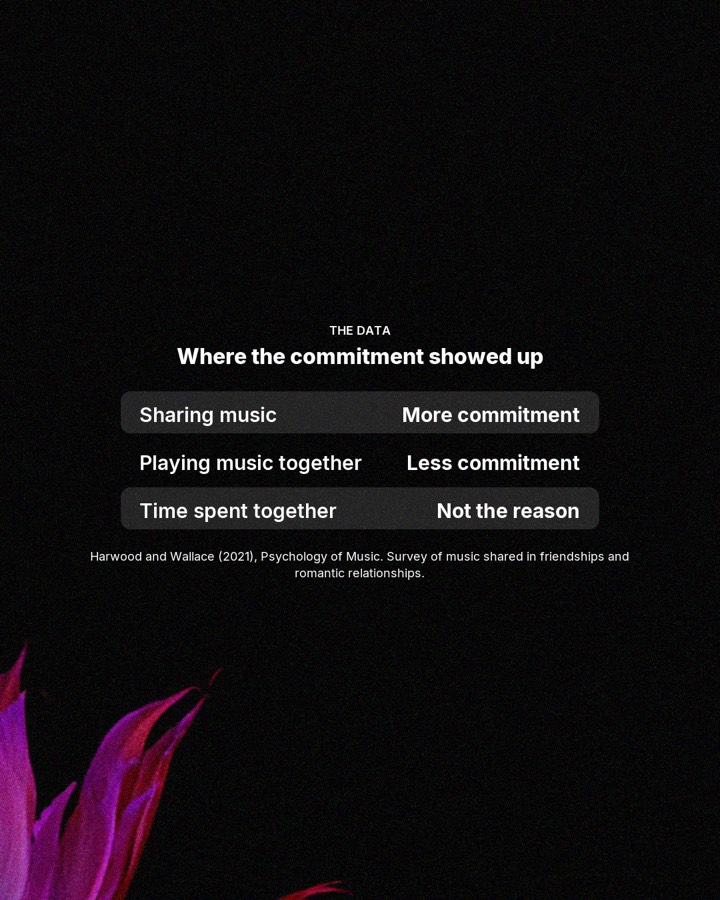
Where the commitment showed up
| Sharing music | More commitment |
| Playing music together | Less commitment |
| Time spent together | Not the reason |
Keep the playlist going
In relationships and close friendships alike, the effect ran through feeling in sync with the other person. Sending them the next track is the smallest way to stay there.
Researchers asked people about the music they share with a partner or a close friend, then how committed they felt to them. More sharing, more commitment, and it ran through feeling in sync. The surprise the authors flag themselves: pairs who sat down and played music together reported less. All of it is associations from a survey answered by one person per pair, so nothing here proves cause.
Sources
Harwood, J., & Wallace, S. D. (2021). "Shared musical activity and perceptions of relationship commitment." Psychology of Music, 50(6). doi:10.1177/03057356211058779
"Music across the love-span: a mixed methods study into the use of music in romantic relationships." https://pmc.ncbi.nlm.nih.gov/articles/PMC12631075/