Rave to the grave holds up in the research

Talk yourself into it, not out of it
Researchers surveyed 136 women aged 40 to 65 who never stopped raving, and only 7.3% had ever heard a negative comment about their age on a night out. The pressure to retire is mostly internal.
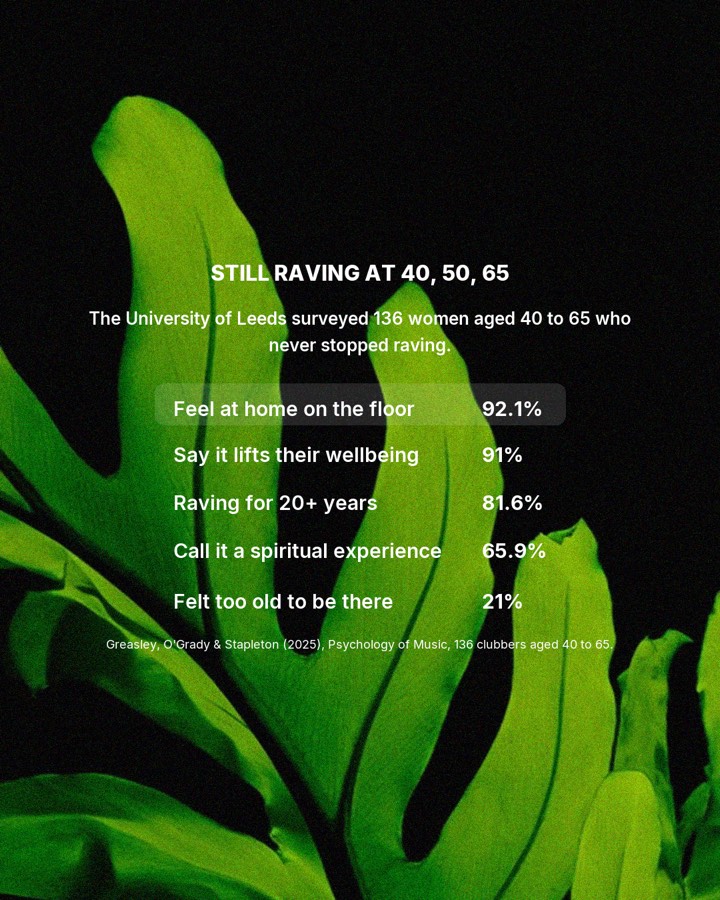
STILL RAVING AT 40, 50, 65
| Feel at home on the floor | 92.1% |
| Say it lifts their wellbeing | 91% |
| Raving for 20+ years | 81.6% |
| Call it a spiritual experience | 65.9% |
| Felt too old to be there | 21% |
The University of Leeds surveyed 136 women aged 40 to 65 who never stopped raving: 92.1% feel at home on the floor and 91% say it lifts their wellbeing. The study is honest about the hard part too, unwanted attention is real, and the women manage it by moving in crews and picking underground rooms. In a separate six-month trial, dancers aged 63 to 80 added more brain volume than a fitness group, the opposite direction to normal aging.
Sources
Greasley, O'Grady & Stapleton (2025). "Age is just a number: Persistent participation in Electronic Dance Music by women over 40." Psychology of Music. https://eprints.whiterose.ac.uk/id/eprint/220596/
Rehfeld et al. (2018). "Dance training is superior to repetitive physical exercise in inducing brain plasticity in the elderly." PLOS ONE. https://journals.plos.org/plosone/article?id=10.1371/journal.pone.0196636