Earplugs don't ruin the night that is the myth
Someone ran the experiment
Someone ran the experiment
Fifty-one people at an Amsterdam festival were split at random: half wore earplugs across the four and a half hours, half went without. Everyone's hearing was tested afterwards. In the unprotected group, 42 percent of ears came out with a temporary dip. In the earplug group it was 8 percent.
Same festival, same hours, different ears
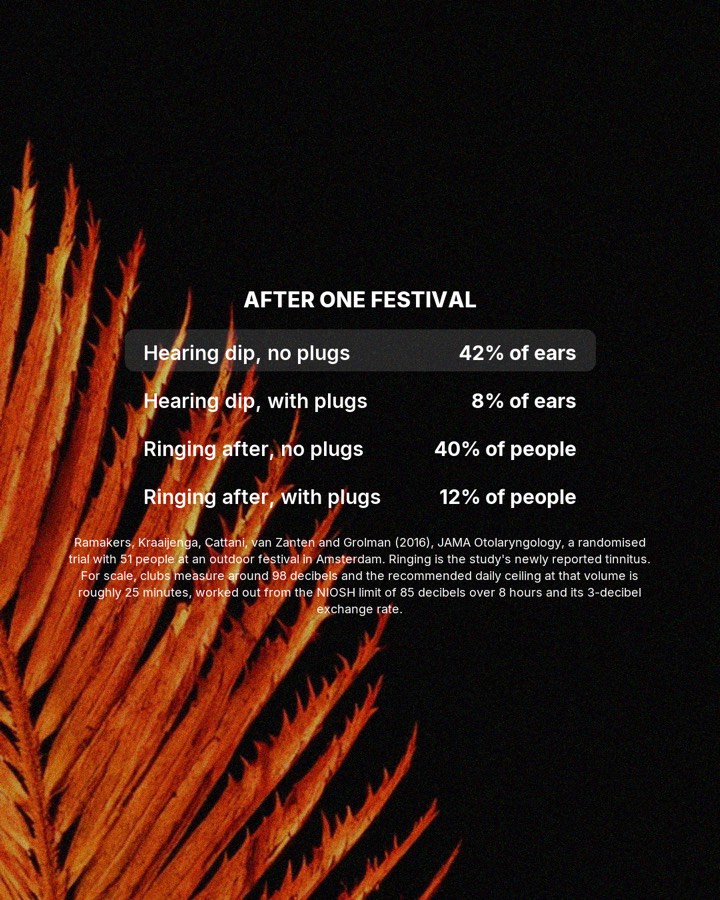
AFTER ONE FESTIVAL
| Hearing dip, no plugs | 42% of ears |
| Hearing dip, with plugs | 8% of ears |
| Ringing after, no plugs | 40% of people |
| Ringing after, with plugs | 12% of people |
Protect your ears, keep the sound
Filtered earplugs cut evenly across frequencies, so the music stays balanced. Foam cuts the highs hardest, which is why foam sounds muffled.
Fifty-one people at an Amsterdam festival, split at random: half in earplugs for four and a half hours, half without. Afterwards 42 percent of unprotected ears had a temporary dip, against 8 percent of the protected ones, and ringing went 40 percent against 12. The two kinds of plug also measure differently: foam cuts the highs hardest and sounds muffled, filtered plugs cut evenly, so the music just gets quieter.
Sources
Ramakers, G.G.J., Kraaijenga, V.J.C., Cattani, G., van Zanten, G.A., & Grolman, W. (2016). "Effectiveness of Earplugs in Preventing Recreational Noise-Induced Hearing Loss: A Randomized Clinical Trial." JAMA Otolaryngology-Head & Neck Surgery, 142(6), 551-558. https://pubmed.ncbi.nlm.nih.gov/27054284/
Boissinot, E., Bogdanovitch, S., Bocksteal, A., & Guastavino, C. (2022). "Effect of hearing protection use on pianists' performance and experience: Comparing foam and musician earplugs." Frontiers in Psychology, 13, 886861. https://pmc.ncbi.nlm.nih.gov/articles/PMC9315358/