3 reasons you drift toward the same people every rave
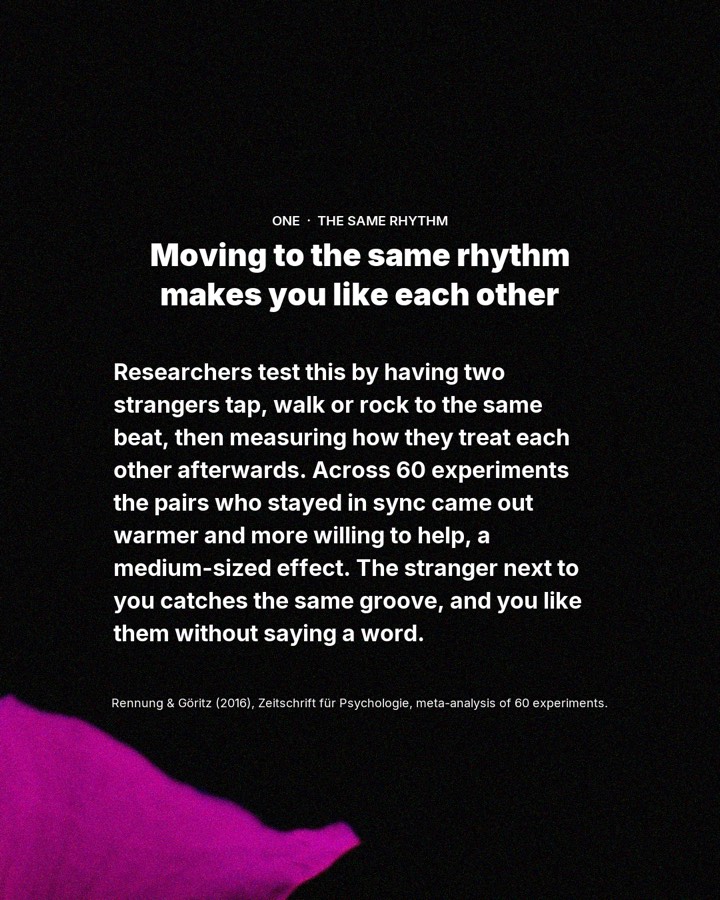
Moving to the same rhythm makes you like each other
Researchers test this by having two strangers tap, walk or rock to the same beat, then measuring how they treat each other afterwards. Across 60 experiments the pairs who stayed in sync came out warmer and more willing to help, a medium-sized effect. The stranger next to you catches the same groove, and you like them without saying a word.
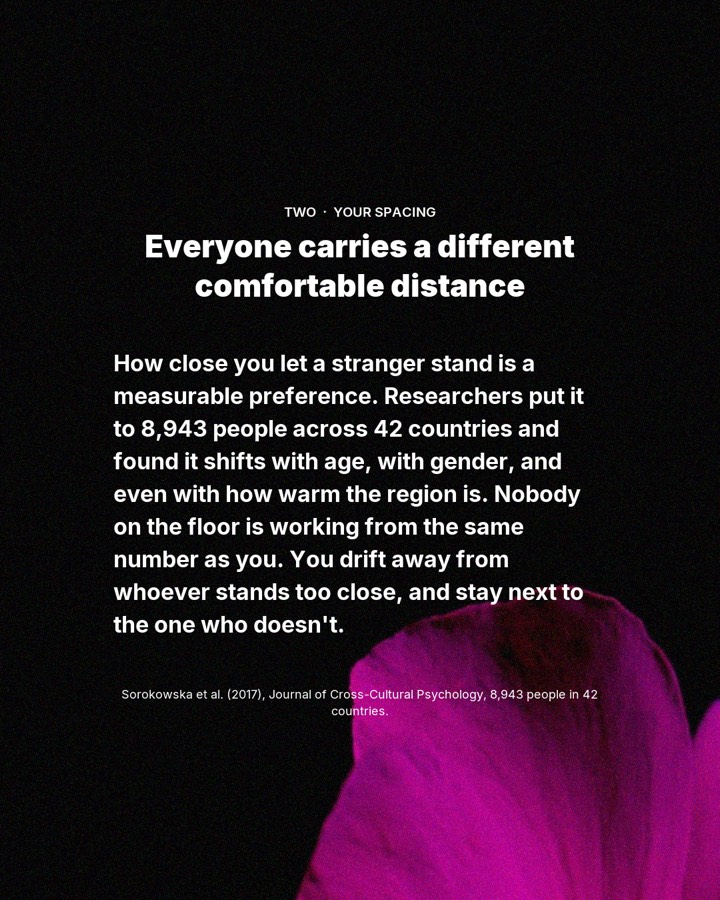
Everyone carries a different comfortable distance
How close you let a stranger stand is a measurable preference. Researchers put it to 8,943 people across 42 countries and found it shifts with age, with gender, and even with how warm the region is. Nobody on the floor is working from the same number as you. You drift away from whoever stands too close, and stay next to the one who doesn't.
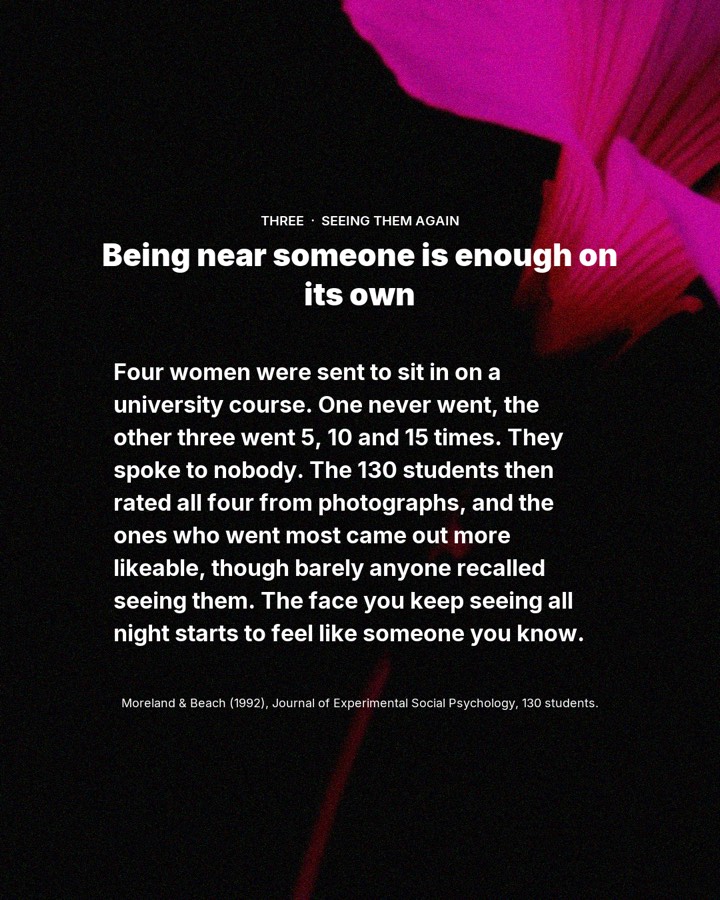
Being near someone is enough on its own
Four women were sent to sit in on a university course. One never went, the other three went 5, 10 and 15 times. They spoke to nobody. The 130 students then rated all four from photographs, and the ones who went most came out more likeable, though barely anyone recalled seeing them. The face you keep seeing all night starts to feel like someone you know.
Every study here was run somewhere other than a dancefloor, on tapping tasks, survey questions and a university lecture course, so the rave reading is ours and the findings are theirs. What they each give you is a mechanism. Sixty experiments say moving to the same rhythm as someone leaves you warmer towards them. Nearly nine thousand people across 42 countries say the distance you keep is a real preference and not the same as the next person's. And 130 students rated four women higher after sharing a room with them, without clocking that they had seen them before. Put those together on a floor and you can see why you keep ending up beside the same person.
Sources
Rennung & Göritz (2016). "Prosocial Consequences of Interpersonal Synchrony: A Meta-Analysis." Zeitschrift für Psychologie, 224(3), 168-189. https://pmc.ncbi.nlm.nih.gov/articles/PMC5137339/
Sorokowska et al. (2017). "Preferred Interpersonal Distances: A Global Comparison." Journal of Cross-Cultural Psychology, 48(4), 577-592. https://doi.org/10.1177/0022022117698039
Moreland & Beach (1992). "Exposure effects in the classroom: The development of affinity among students." Journal of Experimental Social Psychology, 28(3), 255-276. https://doi.org/10.1016/0022-1031(92)90055-O