Your FOMO is not about the party
Text your friends
The first big FOMO study found it was strongest in people who felt disconnected, not in people missing the best parties. It also fades as you get older. So when it hits, message the people you'd have gone out with.
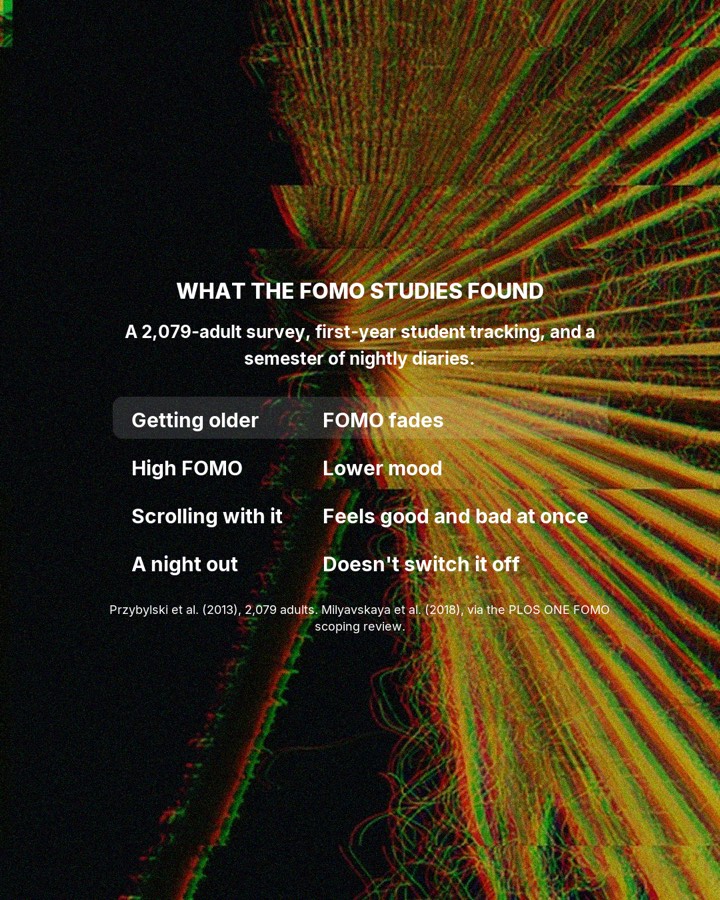
WHAT THE FOMO STUDIES FOUND
| Getting older | FOMO fades |
| High FOMO | Lower mood |
| Scrolling with it | Feels good and bad at once |
| A night out | Doesn't switch it off |
Researchers built the first FOMO scale in 2013 and ran it on 2,079 adults: it was strongest in people low on connection, autonomy and competence, and came with measurably lower mood. A semester-long diary study found the feeling shows up even when you're out doing something you chose. And it fades with age.
Sources
Przybylski, Murayama, DeHaan & Gladwell (2013). "Motivational, emotional, and behavioral correlates of fear of missing out." Computers in Human Behavior.
PLOS ONE scoping review of FOMO, digital technology use and wellbeing. https://journals.plos.org/plosone/article?id=10.1371/journal.pone.0308643