Closing your eyes changes how hard the music lands
Two things happen at once
Two things happen at once
Researchers played people the same music with their eyes open and then closed. With the eyes shut, listeners rated it more emotional, and the amygdala, the part of the brain that handles emotional weight, worked harder.
Same track, more feeling
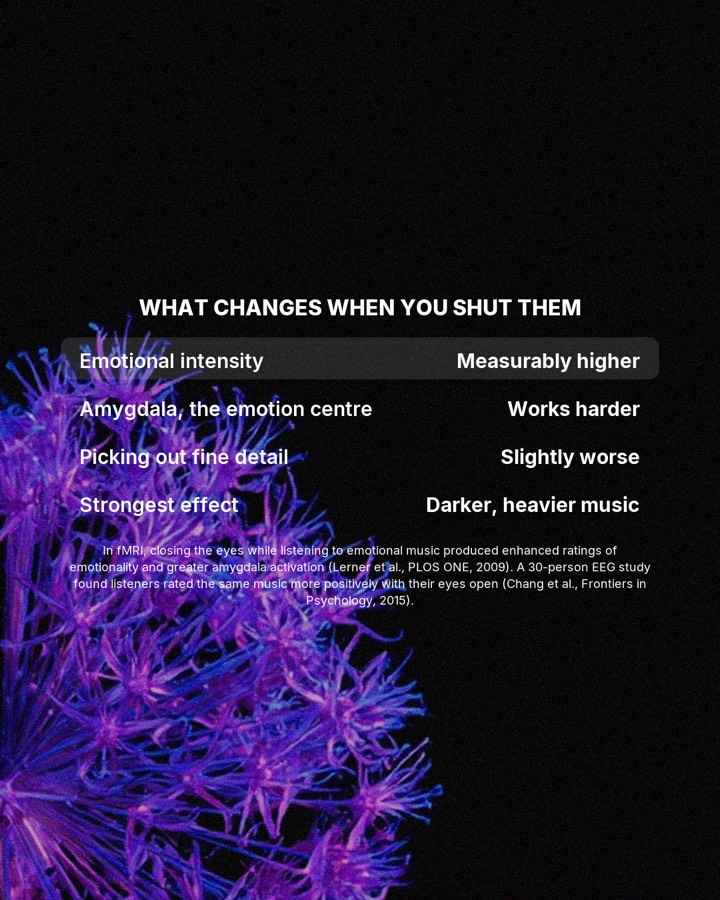
WHAT CHANGES WHEN YOU SHUT THEM
| Emotional intensity | Measurably higher |
| Amygdala, the emotion centre | Works harder |
| Picking out fine detail | Slightly worse |
| Strongest effect | Darker, heavier music |
Close your eyes on the build
The tension before a drop is the part that does the work, and it is usually the part your mind drifts through.
Same music, eyes open then closed. Closed, people rated it more emotional and the amygdala, the brain's emotion centre, worked harder. Fine detail gets slightly worse, so save it for the build.
Sources
Lerner, Y., Papo, D., Zhdanov, A., Belozersky, L., & Hendler, T. (2009). "Eyes Wide Shut: Amygdala Mediates Eyes-Closed Effect on Emotional Experience with Music." PLOS ONE. https://journals.plos.org/plosone/article?id=10.1371/journal.pone.0006230
Chang, Lee, Liang, Chen, Tsai & Hsieh (2015). "Experiencing affective music in eyes-closed and eyes-open states: an electroencephalography study." Frontiers in Psychology. https://pmc.ncbi.nlm.nih.gov/articles/PMC4528089/
Götz, T., Hanke, D., Huonker, R., Weiss, T., Klingner, C., Brodoehl, S., Baumbach, P., & Witte, O. W. (2017). "The Influence of Eye Closure on Somatosensory Discrimination: A Trade-off Between Simple Perception and Discrimination." Cerebral Cortex, 27(6). https://academic.oup.com/cercor/article/27/6/3231/3605005