Going hard bonds a room
Four rooms, four ways to move
Four rooms, four ways to move
264 teenagers on Marajo Island in Brazil, in groups of three. Half were put on their feet for a full body routine, half stayed seated and moved only their hands. Within each half, some mirrored each other move for move and some did whatever they liked.
Sweat and timing were separated
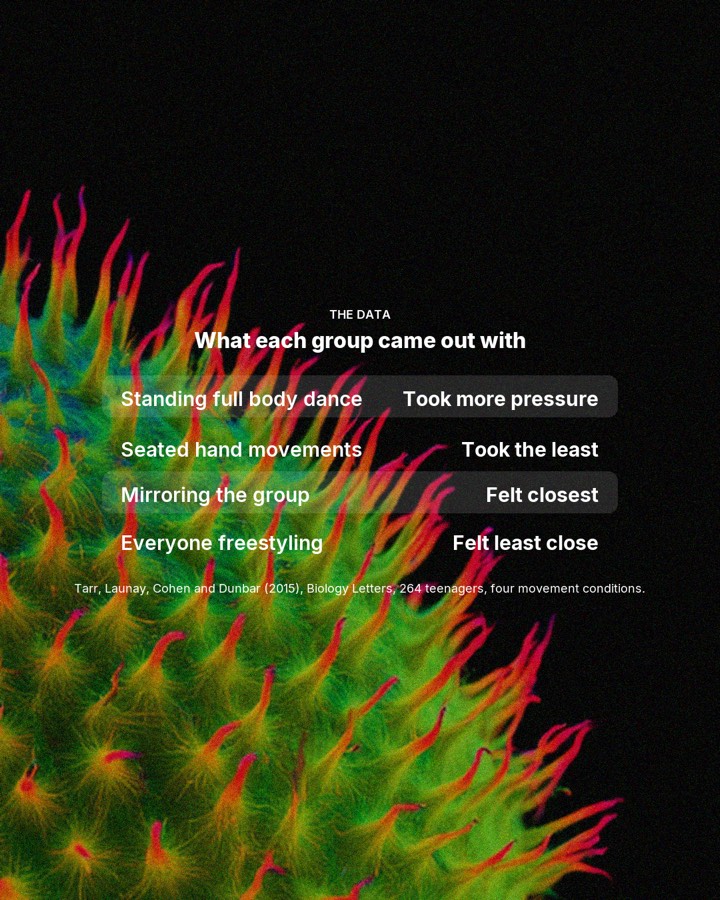
What each group came out with
| Standing full body dance | Took more pressure |
| Seated hand movements | Took the least |
| Mirroring the group | Felt closest |
| Everyone freestyling | Felt least close |
Either one is enough
Go hard without matching anyone, or match without breaking a sweat. Neither needed the other.
Researchers took 264 teenagers on Marajo Island in Brazil and pulled dancing apart into its two halves. Groups of three either stood for a full body routine or stayed seated moving only their hands, and within each of those, some mirrored each other move for move while others did whatever they liked. Afterwards everyone had a blood pressure cuff tightened on one arm until it got uncomfortable, which is a rough read on the body's own painkillers, and was asked how close they felt to their group. The ones who had been on their feet took more pressure than the ones who stayed seated. The ones who mirrored each other felt closest to their group. Sweat did it without timing, timing did it without sweat, and neither needed the other to work.
The carousel

Sources
Tarr, B., Launay, J., Cohen, E., & Dunbar, R. (2015). "Synchrony and exertion during dance independently raise pain threshold and encourage social bonding." Biology Letters, 11(10), 20150767. doi:10.1098/rsbl.2015.0767 · PMID 26510676 · https://pubmed.ncbi.nlm.nih.gov/26510676/ · full text https://pmc.ncbi.nlm.nih.gov/articles/PMC4650190/ Abstract fetched via the PubMed E-utilities API and the full text via PMC, both 2026-08-13.