Why good bass makes you scowl
The stankier the face, the better the feeling
Psychologists find that when a feeling maxes out, it often shows up on your face as the opposite. People cry at reunions and scowl at perfect drops. The bigger the feeling, the stankier the face: a proper scowl just means the drop landed.
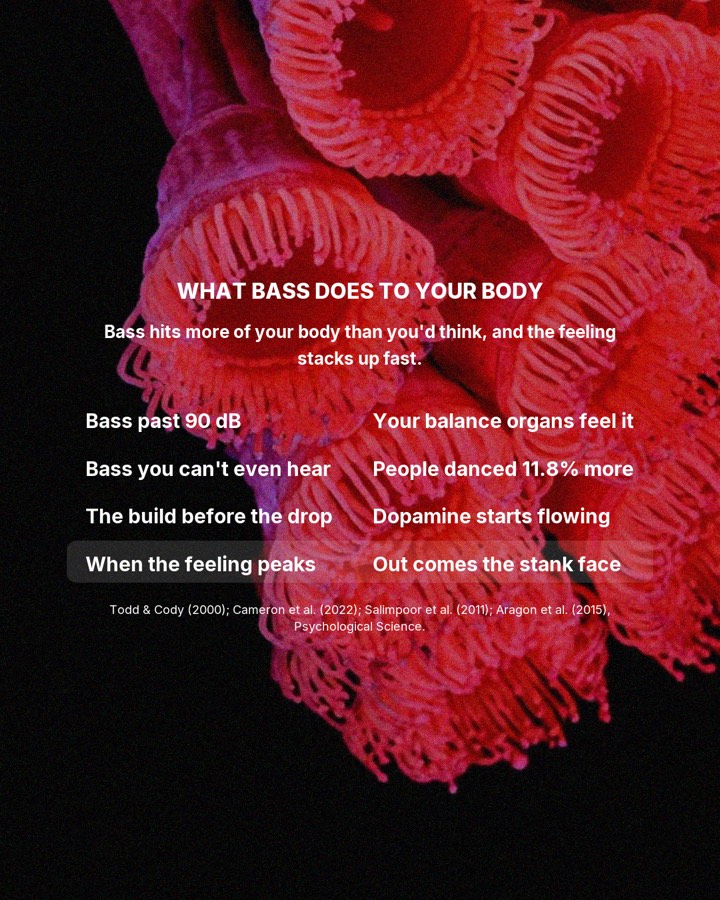
WHAT BASS DOES TO YOUR BODY
| Bass past 90 dB | Your balance organs feel it |
| Bass you can't even hear | People danced 11.8% more |
| The build before the drop | Dopamine starts flowing |
| When the feeling peaks | Out comes the stank face |
Yale psychologists call them dimorphous expressions: intense positive emotion often comes out looking negative, like crying at good news. Their studies used cute overload, not clubs, but the mechanism fits the dancefloor. Bass past 90 decibels reaches your balance organs, sub-bass you can't hear still moves you, and dopamine is flowing before the drop even lands. A feeling that big has to go somewhere, and it picks your face. The stankier the face, the better the feeling.
Sources
Aragón, O.R., Clark, M.S., Dyer, R.L., & Bargh, J.A. (2015). "Dimorphous expressions of positive emotion: displays of both care and aggression in response to cute stimuli." Psychological Science, 26(3), 259-273. https://pubmed.ncbi.nlm.nih.gov/25626441/
Todd, N.P., & Cody, F.W. (2000). "Vestibular responses to loud dance music: a physiological basis of the 'rock and roll threshold'?" Journal of the Acoustical Society of America, 107(1), 496-500. https://pubmed.ncbi.nlm.nih.gov/10641657/
Cameron, D.J., Dotov, D., Flaten, E., Bosnyak, D., Hove, M.J., & Trainor, L.J. (2022). "Undetectable very-low frequency sound increases dancing at a live concert." Current Biology, 32(21), R1222-R1223. https://pubmed.ncbi.nlm.nih.gov/36347227/
McMaster University News (2022). "Want to fire up the dance floor? Play low-frequency bass." https://news.mcmaster.ca/want-to-fire-up-the-dance-floor-play-low-frequency-bass/
Salimpoor, V.N., Benovoy, M., Larcher, K., Dagher, A., & Zatorre, R.J. (2011). "Anatomically distinct dopamine release during anticipation and experience of peak emotion to music." Nature Neuroscience, 14(2), 257-262. https://pubmed.ncbi.nlm.nih.gov/21217764/